
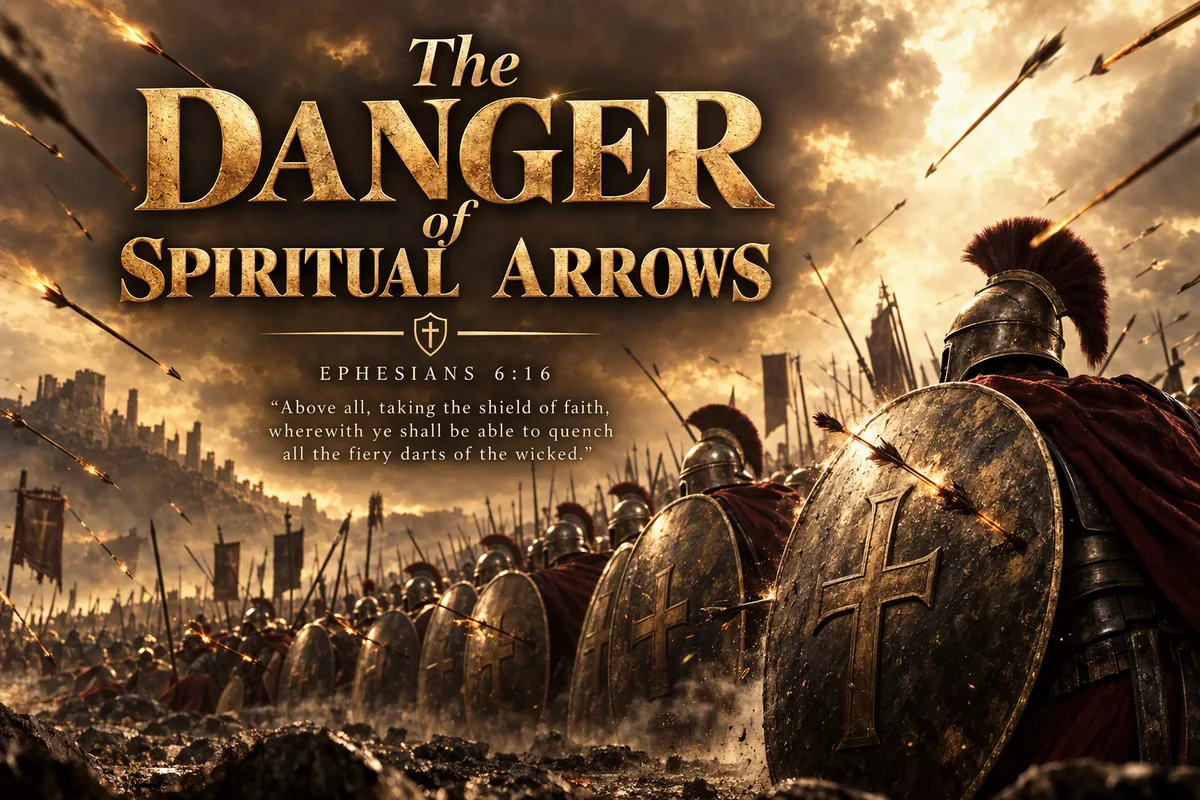
You do not have to be a soldier to come under fire. If you have ever felt a sudden pull toward something you know is not God's best for you, a thought that would not leave, or a heaviness that seemed to come out of nowhere, you have met what Scripture calls a fiery dart. In our teaching series The Danger of Spiritual Arrows, we are learning how to recognize those arrows early and how to stop them before they do damage.
“Above all, taking the shield of faith, wherewith ye shall be able to quench all the fiery darts of the wicked.”
Ephesians 6:16 (KJV)
What Are Spiritual Arrows?
Paul reminds us that “we wrestle not against flesh and blood, but against principalities, against powers, against the rulers of the darkness of this world” (Ephesians 6:12). Our battle is real, but it is not usually loud. The enemy rarely announces himself. He shoots.
A spiritual arrow is any attack aimed at your heart, mind, home or calling: a lie you start to believe about yourself, an urge that pulls you off course, a wave of discouragement right when you were gaining ground, an offense that tempts you to walk away from people God gave you. The psalmist knew this kind of attack well and wrote of God's protection from “the arrow that flieth by day” (Psalm 91:5).
The good news is that arrows can be seen in flight. You do not have to wait until one lands to deal with it.
How an Arrow Becomes a Wound
We often talk about temptation as a single moment: one minute you were fine, the next you were not. Scripture describes it as a process, and that is good news, because a process can be interrupted.
James lays out the sequence: a person “is drawn away of his own lust, and enticed. Then when lust hath conceived, it bringeth forth sin: and sin, when it is finished, bringeth forth death” (James 1:14–15).
Walk through those steps slowly. There is a desire. Then a draw, the moment it starts to pull you away. Then the enticement, when it begins to look good. Then conception, when you agree with it inside. Then birth, when it becomes action. And finally death, when it does its damage to your peace, your relationships or your walk with God.
Notice where agreement sits: right in the middle. Long before anything is born, there is a moment when we say yes on the inside. That is why the urge itself is so important to recognize. Being tempted is not the same as sinning; Jesus “was in all points tempted like as we are, yet without sin” (Hebrews 4:15). But the urge is how the attack arrives. It is the arrow in the air, looking for somewhere to land.
Every Arrow Has an Archer and a Target
An arrow is never random. Someone draws the bow, and someone aims it. Darts are always thrown at something.
When most of us feel a strong pull, we ask one question: Is this wrong? That is a good question. But discernment asks a second one: What is this trying to hit?
The target often tells you more than the temptation does:
- An urge to quit right before a breakthrough is aimed at your harvest.
- An urge to withdraw from people who love you is aimed at your covenant community.
- An urge to prove yourself is aimed at your identity in Christ.
- An urge to compare is aimed at your contentment and gratitude.
- An urge to rush is aimed at your trust in God's timing.
Here is the word to hold on to: the target often reveals the assignment the enemy fears most. Nobody aims at an empty field. If the pressure keeps landing in the same place in your life, there may be something planted there that Heaven intends to grow.
This changes how we pray. Instead of only praying, “Lord, take this away,” we can also pray, “Lord, show me what this is aimed at, and help me guard it.” What was sent to wound you can end up showing you where to stand.
Three Arrows in the Wilderness
The clearest picture of reading the aim is Jesus in the wilderness (Matthew 4:1–11). Just before, at the Jordan River, the Father spoke over Him: “This is my beloved Son, in whom I am well pleased” (Matthew 3:17). Then the Spirit led Him into the desert, and after forty days of fasting the arrows came. Every one of them was aimed at what the Father had just declared.
The first arrow was aimed at His provision. “If thou be the Son of God, command that these stones be made bread.” Jesus was truly hungry, and bread is not evil. The urge was to meet a real need outside the Father's timing.
The second arrow was aimed at His trust. Satan took Him to the pinnacle of the temple and said, “Cast thyself down,” and then quoted Psalm 91 to make his case. Let that sink in: the enemy knows Scripture well enough to twist it. A spiritual arrow does not always sound ungodly. Sometimes it sounds like a verse used for the wrong purpose.
The third arrow was aimed at His assignment. “All these things will I give thee, if thou wilt fall down and worship me.” The kingdoms of the world were already promised to the Son. The urge was to take them by a shortcut that skipped the cross.
Notice what Jesus did not do. He did not argue, explain or negotiate. Each time He answered, “It is written” (Deuteronomy 8:3; 6:16; 6:13). He knew who He was because the Father had already said it. Identity settled at the river held steady in the desert.
Timing Is a Tell
Arrows are not only aimed. They are timed.
Second Samuel 11 opens with a sentence every believer should notice: “at the time when kings go forth to battle… David tarried still at Jerusalem.” After a long run of victories, in the season he should have been leading, David was at home. One evening he walked out on his roof and saw Bathsheba. The arrow did not find David on the battlefield. It found him idle, comfortable and alone.
Jesus faced His wilderness arrows at the end of forty days without food, when the body was at its weakest. And when the devil left, Luke adds a quiet warning: he departed “for a season” (Luke 4:13). He would look for another opening.
Learn the seasons when arrows fly hardest:
- Right after a victory, when we relax our guard.
- Right before a promotion or new assignment, when there is the most to lose.
- In seasons of fatigue, when we are hungry, angry, lonely or tired.
- In seasons of idleness, when we are not where we are supposed to be.
This is not meant to make you anxious; it is meant to keep you from being surprised. When the pull gets stronger, check the calendar of your soul. Are you tired? Isolated? Did you just win something big? Then rest, reach out and stay close to God and your church family. Sometimes the most spiritual thing you can do is go to bed early and call a friend.
How to Quench the Fiery Darts of the Enemy
Paul does not tell us to wish the arrows away. He tells us to take up the shield of faith, “wherewith ye shall be able to quench all the fiery darts of the wicked.” Faith does not stop the arrow from being fired. It puts out the fire when the arrow hits. That is the heart of Part 2 of our series, Quench It.
Here is what quenching looks like on an ordinary Tuesday:
- Name it. Say plainly, even if only to yourself, “This is an urge, and it is aimed at something.” Naming it pulls it out of the shadows.
- Read the aim. Ask, “What is this trying to hit: my peace, my marriage, my calling, my finances, my witness?”
- Answer it with the Word. Do what Jesus did. Find the scripture that speaks to that target and say it out loud. “It is written” still works.
- Change your location. If the arrow keeps finding you in the same place, move. Close the app, leave the room, take a different route home. Joseph ran, and he kept his calling (Genesis 39:12).
- Tell someone. “Confess your faults one to another, and pray one for another, that ye may be healed” (James 5:16). Arrows lose much of their power in the light.
Resisting a strong pull takes patience, courage and practice. But someone has to stand guard over your life, and you do not stand there alone. The Holy Spirit stands with you, and so does a church family that will pray with you.
God Is Not Against Your Desires
God is not against desire. He created it. Hunger, longing, ambition and love are part of how He made us. The enemy's arrows are usually good desires bent toward the wrong target, the wrong timing or the wrong source.
So the answer is not to stop wanting. It is to let God reorder what we want. “Delight thyself also in the LORD; and he shall give thee the desires of thine heart” (Psalm 37:4). Delight comes first. As we delight in Him, He shapes our desires until what we want begins to match what He is doing, and the urges that used to pull us away start to pull us toward Him.
A Closing Word
If you are in a season of strong pulls right now, hear this: the arrow is not stronger than the shield, and the urge is not stronger than the Word in you. You are not going under.
Do not be discouraged that the arrows are flying. It may mean you are carrying something worth aiming at. Lift your shield, read the aim, answer with what is written, and keep walking. The One who was tempted in every way we are “is able to succour them that are tempted” (Hebrews 2:18).
Frequently Asked Questions
What are the fiery darts of the wicked?
In Ephesians 6:16, the fiery darts are the attacks the enemy aims at believers: lies, accusations, temptations and sudden waves of fear or discouragement. Like flaming arrows in ancient warfare, they are meant to wound and to spread fire.
What does it mean to quench a spiritual arrow?
To quench is to put out the fire. The shield of faith does not stop every arrow from being fired, but it keeps the attack from catching hold of your heart and spreading into action.
How do I know whether a thought is a spiritual attack?
Ask two questions: is it in line with Scripture, and what is it trying to hit? A pull that targets your identity, your relationships or your calling, especially in a tired or lonely season, deserves to be weighed carefully, prayed over and talked through with someone you trust.
Scripture quotations are from the King James Version. Adapted from “The Urge Is the Arrow,” first published in The Altar's Report™.